It is a fair question. The plant sits on the windowsill, or you see a leaf in the supermarket, the gel inside looks clean and cool, and you wonder whether you could simply eat it. Many women ask this, and the answer is less simple than the leaf looks.
In short: we would not eat Aloe Vera straight from a houseplant or a shop-bought leaf. Just under the green skin sits a yellow sap that contains aloin, a strong natural laxative, and at home you cannot tell how much of it is left. If you have already eaten some, what people notice is usually an upset stomach, but there are times to call a pharmacist or doctor, listed below.
What is in the leaf, and why does it matter?
All Aloe Vera naturally contains a thin layer of bitter yellow latex just beneath the green skin. That latex holds a family of compounds called anthraquinones. The best known is aloin. These compounds are very bitter and have a strong laxative effect, which is why the latex was historically used as a purgative.
The clear gel is what most people picture eating. But the sap sits right against it. When a leaf is cut open, the sap can end up on the gel, and the eye cannot judge how much.
That is the whole reason for caution. It is not that Aloe Vera is a dangerous plant. It is that the part you cannot see is the part that matters.
Can you drain or rinse the leaf at home?
Many people assume a good rinse solves it. We would not rely on that. Draining and rinsing a leaf at home is not the same as the purifying process that removes aloin, and once a leaf is cut open there is no way to tell how much sap is left.

Purifying is done by a manufacturer. A decolourising step filters out the anthraquinones so that essentially none remain, and the maker knows what is in the finished product. In a kitchen you have no way to check. The gel may look clear and still carry some of the sap.
For this reason we do not give instructions for preparing a raw leaf to eat. We could not promise they would be safe. Using a leaf on the skin is a separate question, which we cover in fresh Aloe Vera leaf on your face.
What do the EU rules say?
You may have read that Aloe Vera was "banned" in Europe and then "unbanned". The real picture is narrower, and it is about the same yellow sap.
In 2021 the EU placed Aloe Vera leaf preparations that contain aloin and related compounds on its list of substances not allowed in food. In November 2024 an EU court annulled most of that rule. Germany's Federal Institute for Risk Assessment (BfR) still advises caution with Aloe Vera products that keep these compounds.
For you at home, the point is simple. A raw leaf still carries its aloin, and aloin is what the whole debate has been about. It has never been about Aloe Vera once the aloin has been removed. Our guide to aloin and the EU rules sets out the timeline in full.
What if you have already eaten some?
Try not to worry. What people notice depends on how much they ate and how much sap came with it. Some notice an upset stomach, cramping or loose stools.

The sensible steps are simple:
- Do not eat any more of the leaf.
- Sip water through the day, and rest if you feel unsettled.
- Before you take anything for your stomach, ask a pharmacist what is suitable.
When to call a pharmacist or doctor
Please speak to a pharmacist or your GP the same day if:
- you ate a lot, or you are not sure how much;
- the cramps are strong or do not ease;
- you are pregnant or breastfeeding;
- a child was the one who ate it;
- you have kidney problems;
- you take regular medicines, such as tablets for diabetes, heart rhythm, water tablets or blood thinners.
If you feel very unwell and cannot reach anyone, call your local emergency number. Carry on with any prescribed medicine exactly as your doctor has told you.
Purified Aloe Vera is a different thing
A raw leaf and a purified product are not the same material. In purified, anthraquinone-free Aloe Vera the aloin has been taken out. Freeze-drying then gently removes the water from the gel, leaving a concentrated powder that can go into capsules. On a label, the useful words are "anthraquinone-free", "aloin-free" and "purified". Our page on whether Aloe Vera is safe explains tolerance and who should take care.
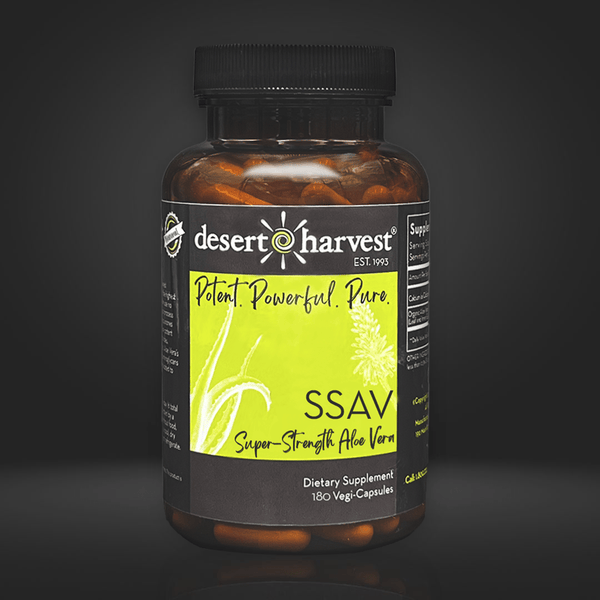
One example is Super-Strength Aloe Vera (SSAV), Desert Harvest's freeze-dried, purified, anthraquinone-free Aloe Vera in capsules, made for daily use. It is a food supplement, not a medicine. If you are pregnant, breastfeeding or take medication, speak to your doctor or pharmacist before starting it. Our guide to how to take Aloe Vera capsules covers the practical side.
And if you have bladder symptoms that persist or get worse, a fever, blood in the urine, or pain in your back or side, please see your GP rather than looking for the answer in a supplement.
Good to know