Aloe Vera is one of the most searched topics among people living with a sensitive bladder, yet the science behind it is younger and smaller than the internet often suggests. This guide sets out what is genuinely known in 2026, what is still being studied, and how Aloe Vera fits within Europe’s food-supplement rules — calmly, and without the hype.
The honest state of the evidence
If you want a single, straight answer, here it is: the published research on Aloe Vera and the bladder is limited and largely preliminary. Most of the discussion online traces back to decades of community use rather than to a large body of randomised trials. That does not make the interest meaningless, but it does mean any responsible article has to separate what people report and explore from what has been proven.
There is some formal scientific interest. A clinical trial investigating an Aloe Vera preparation in people with bladder pain has been registered on the US registry ClinicalTrials.gov (identifier NCT04734106, associated with Wake Forest). The existence of a registered trial is worth knowing as background — it tells you the question is being asked properly — but a registered trial is not the same as a finished, peer-reviewed result, and it should not be read as evidence of any outcome.
Charities and clinicians take a measured view too. Organisations such as the COB Foundation and Bladder Health UK, and bodies like the European Association of Urology (EAU), generally note that the evidence for most oral supplements in bladder pain syndrome is limited and that individual experiences vary widely. We cite them here as independent sources of information, not as endorsements of any product.
What a sensitive bladder involves — and the GAG layer

Interstitial cystitis (IC), also called bladder pain syndrome (BPS), is a long-term condition associated with bladder discomfort and a frequent or urgent need to pass urine. UK charity estimates suggest it affects roughly 400,000 people, the majority of them women, though under-diagnosis means the true figure is likely higher. It is not the same as a urinary tract infection, even though the sensations can overlap — a distinction we explore in a sibling article.
The bladder’s protective lining, explained
The inside of the bladder is coated by a protective layer made of glycosaminoglycans, usually shortened to the GAG layer. Researchers studying IC/BPS have explored the idea that this lining can become more permeable in some people, which is one of several theories about why the bladder may feel sensitive. This is an area of ongoing scientific discussion rather than settled fact. For a plain-English walk-through, see our guide to the bladder’s GAG layer.
Where Aloe Vera enters the conversation
Aloe Vera is a composition story before it is anything else. The plant is naturally a source of polysaccharides, including a long-chain sugar called acemannan, which sit in the gel-rich portion of the leaf. Laboratory scientists have studied these polysaccharides in cell and test-tube models, and that early in-vitro curiosity is part of why Aloe Vera keeps coming up in bladder forums.
It is important to be clear about what that means. Interest in a compound inside a laboratory is not the same as a proven effect in a person. Stating that Aloe Vera contains acemannan and polysaccharides is a fact about what is in the plant; it is not a claim that those substances do anything in your body.
Anthraquinone-free: a composition and quality fact

All Aloe Vera naturally contains compounds called anthraquinones — chiefly aloin (also known as barbaloin) — concentrated in the bitter yellow latex just beneath the leaf skin. These are the substances behind Aloe Vera’s traditional reputation as a harsh laxative, and they are the focus of European regulatory attention.
Higher-quality Aloe Vera supplements have the aloin removed by a purifying, decolourising process, which is why you will see the term anthraquinone-free on a label. The thing to look for is not which part of the leaf was used, but whether the anthraquinones have been taken out — described as anthraquinone-free, aloin-free, purified or decolourised. This is a description of composition and processing, not a health claim. If you want to understand what the wording actually guarantees, read our explainer on anthraquinone-free Aloe Vera.
Aloe Vera and EU food-supplement rules
Two things matter here. First, Aloe Vera currently has no authorised EU health claims — the relevant entries sit in the non-authorised or “on hold” part of the EU Register — so no legitimate brand may tell you that Aloe Vera treats, prevents or improves any condition. Education about a condition is permitted; product claims are not.
Second, the aloin question has a recent legal twist. Regulation (EU) 2021/468 had restricted Aloe Vera leaf preparations containing hydroxyanthracene derivatives (HADs, including aloin and aloe-emodin) in food. In November 2024 the General Court of the EU annulled the relevant parts of that regulation in case T-189/21 (Aloe Vera of Europe v Commission), except for danthron. Germany’s BfR, meanwhile, continues to advise caution on Aloe Vera preparations that still contain aloin and other anthraquinones. The practical point for readers is straightforward: an aloin-removed, anthraquinone-free Aloe Vera sits outside the HAD concern entirely, regardless of how the legal position evolves.
If you are considering Aloe Vera as part of a routine
People who use Aloe Vera for everyday bladder comfort tend to treat it as a slow, steady part of a daily routine rather than a quick fix. Consistency usually matters more than intensity, and many take it over a period of weeks before deciding whether it suits them. Capsules made from concentrated, freeze-dried, aloin-removed Aloe Vera are popular because the dose is consistent and the anthraquinones have been removed; juices vary far more in concentration and taste — a trade-off we compare in our freeze-dried versus juice guide.
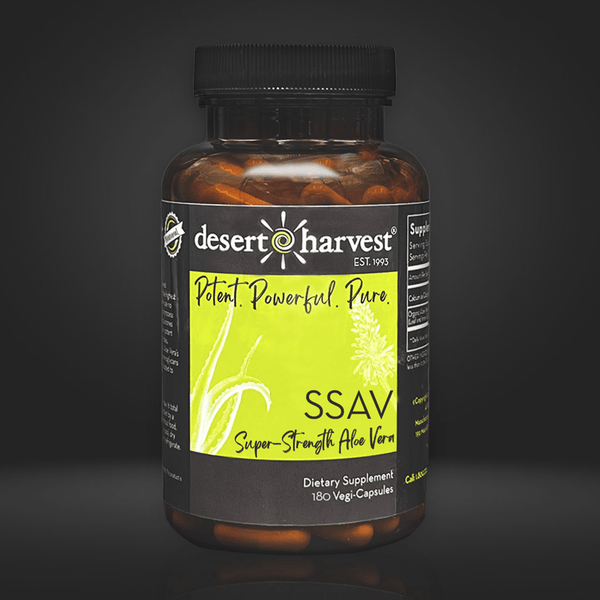
As one option among several, Desert Harvest Super-Strength Aloe Vera is a freeze-dried, anthraquinone-free, 200:1 concentrated Aloe Vera food supplement with the aloin removed by a patented decolourising process, distributed across Europe by Bivio Medical B.V. (Desert Harvest Europe). It is offered as part of a bladder-friendly lifestyle, not as a treatment for any condition. For the bigger picture — the biology, the rules and the daily-life side — start with our pillar guide to Aloe Vera and the bladder.
Whatever you try, speak to your doctor or pharmacist first, especially if you are pregnant, breastfeeding or taking other medication. A food supplement sits alongside a varied diet and a calm routine — never in place of medical advice.

Good to know
Frequently asked questions
What does the research say about Aloe Vera and interstitial cystitis?
How long do people usually try Aloe Vera as part of a bladder-friendly routine?
What are anthraquinones and aloin, and why are they removed from Aloe Vera?
Is Aloe Vera legal in food supplements in the EU?

Food supplement notice. Desert Harvest Super-Strength Aloe Vera is a food supplement, not a medicine, and is not intended to diagnose, treat, cure or prevent any disease. Food supplements should not be used as a substitute for a varied, balanced diet and a healthy lifestyle. Do not exceed the recommended daily intake. If you are pregnant, breastfeeding, taking medication or under medical care, consult your doctor or pharmacist before use. Keep out of the reach of young children.