The bladder's GAG layer is a thin, gel-like coating of sugars and proteins, known as glycosaminoglycans, that lines the inside of the bladder. It rests on the surface of the bladder wall, holds onto a film of water, and acts as a protective barrier between urine and the more delicate tissue underneath. Understanding it is one of the most useful first steps for anyone learning about a sensitive bladder.
What does "GAG layer" actually mean?
GAG is short for glycosaminoglycan — a mouthful of a word for what is really a family of long, chain-like molecules built from sugars. The innermost surface of the bladder is lined by specialised cells called the urothelium, and sitting on top of those cells is a slippery, mucus-like film. That film is the GAG layer.
It is made up mostly of a handful of these glycosaminoglycans:
- Hyaluronic acid (also called sodium hyaluronate), a glycosaminoglycan found throughout the body's connective tissues;
- Chondroitin sulphate, which research suggests is the dominant sulphated GAG on the bladder's luminal surface;
- Heparan sulphate, dermatan sulphate and keratan sulphate, present in smaller amounts.
What makes these molecules special is that they are hydrophilic — water-loving. They bind a thin sheet of water molecules to the bladder surface, and it is partly this watery cushion that does the protecting.
Is the GAG layer the same as the bladder lining?
Not quite. The "bladder lining" usually refers to the urothelium, the layer of living cells. The GAG layer is the protective coating that sits on top of those cells, facing the urine. Together they form the bladder's front line of defence, sometimes described as part of the "blood–urine barrier".
What does the GAG layer do?

It helps to think of the GAG layer as the bladder's non-stick coating. Urine is acidic and carries waste products, salts and other compounds, and the layer keeps that fluid from reaching the living tissue of the bladder wall. A healthy GAG layer is generally understood to help:
- keep irritating substances in urine, such as potassium and other salts, away from the bladder wall;
- discourage bacteria from sticking to the surface;
- hold a protective film of water against the lining;
- keep the surface smooth and well-lubricated as the bladder fills and empties.
Because it does so much, the GAG layer has been studied closely by urologists and researchers for decades.
The "leaky urothelium" idea, explained simply
You may come across the GAG layer in discussions of interstitial cystitis (IC), also called bladder pain syndrome (BPS) — the term increasingly used by the European Association of Urology (EAU). One long-standing idea, often called the "leaky urothelium" theory, suggests that in some people the GAG layer may be thinner or disrupted, allowing substances such as potassium to pass more easily into the bladder wall and contribute to irritation and discomfort.
It is important to be clear that this is a hypothesis rather than a settled fact. Researchers and clinicians still debate how large a role a deficient GAG layer plays, and IC/BPS is a complex condition with several proposed contributing factors. If you want balanced, trustworthy reading on the condition itself, UK charities such as the COB Foundation and Bladder Health UK, and the EAU's patient information, are good places to start.
How is the GAG layer supported in a medical setting?
Because the GAG layer matters, it is an active area of research. In clinical settings, doctors sometimes use what is called GAG replacement therapy — for example, hyaluronic acid or chondroitin sulphate placed directly into the bladder (intravesical instillation), or an oral medicine such as pentosan polysulfate. These are prescribed medical treatments, managed by a urologist, and they are quite separate from food and food supplements. If you think a medical approach might be relevant to you, that is a conversation for your doctor.
Looking after a sensitive bladder day to day

Most people living with a sensitive bladder focus on the everyday things within their control. None of these is a cure, but together they form what many describe as a bladder-friendly routine:
- Diet — some people find that certain foods and drinks feel less comfortable (for many, things like coffee, alcohol, citrus and very acidic or spicy foods), and keep a simple food diary to learn their own pattern;
- Hydration — a steady, sensible fluid intake rather than either flooding or severely restricting;
- Gentle routines — stress management, good sleep and gentle movement;
- Food supplements — chosen as one optional part of a daily routine.
Where Aloe Vera fits in
Aloe Vera is one of the supplements that many people with a sensitive bladder choose to include in their daily routine. It is worth being precise about what it is — and what it is not. Aloe Vera is a food, not a medicine, and we make no claim that it acts on the bladder, the GAG layer or any condition.
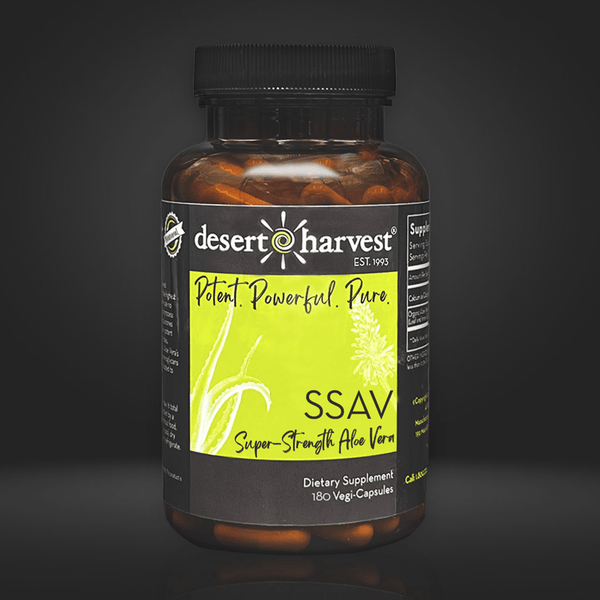
What we can share are simple composition facts. Desert Harvest Super-Strength Aloe Vera is a freeze-dried, anthraquinone-free Aloe Vera food supplement, concentrated to a 200:1 strength. All Aloe Vera naturally contains anthraquinones — the bitter yellow compounds, chiefly aloin, found in the leaf — and "anthraquinone-free" means those have been removed by a patented decolourising process. That is the detail worth looking for when comparing Aloe Vera products: not which part of the leaf it came from, but whether the aloin has been taken out. A purified, decolourised Aloe Vera is a different proposition from ordinary Aloe Vera juice. It is also naturally a source of Aloe Vera polysaccharides, including acemannan.
If you would like the bigger picture — what a sensitive bladder feels like, what the research explores and how the EU rules work — our plain-English guide to Aloe Vera and the bladder brings it together in one place. You can also read why the processing matters in our companion article on anthraquinone-free Aloe Vera.

Good to know
Frequently asked questions
What is the GAG layer and what does Aloe Vera have to do with it?
What is the difference between interstitial cystitis and a UTI?
Is Aloe Vera safe for a sensitive bladder?
Can men take Aloe Vera too?
What does GAG stand for?
What is GAG layer replacement therapy?
Does menopause affect the GAG layer?

Desert Harvest Super-Strength Aloe Vera is a food supplement, distributed in Europe by Bivio Medical B.V. (Desert Harvest Europe). Food supplements are not a substitute for a varied, balanced diet and a healthy lifestyle, and should not be used to treat, prevent or cure any disease. This article is general educational information, not medical advice. If you have bladder symptoms or a diagnosed condition, or if you are pregnant, breastfeeding or taking medication, please consult your doctor or pharmacist.