Acemannan is rarely sold on its own. What you find in a shop is an Aloe Vera supplement that says it contains it, and the labels differ more than they first appear. This guide sets out what to look at before you buy.
In short: Check three things: the Aloe Vera is purified so the aloin is removed, it is freeze-dried rather than a diluted liquid, and the label gives a clear strength and a clear daily amount. In the EU a label may say what is in the product, but it may not promise a health effect.
What an acemannan supplement actually is
Acemannan is the main polysaccharide in Aloe Vera gel. A polysaccharide is simply a long chain of sugar units. The plant makes acemannan itself, so it is naturally present in the gel and is not added. Our guide to acemannan and Aloe Vera polysaccharides explains the science, so we will not repeat it here.
For a buyer, one point matters most. You cannot really buy acemannan on its own. You buy an Aloe Vera preparation that was made to keep the gel fraction, or one that was not. "Contains Aloe Vera" and "keeps the acemannan" are not the same claim.
These long chains are delicate. Heat, time and rough handling can break them down for good, so handling after harvest matters as much as the plant.
Why the form matters: freeze-dried, juice or gel
The same plant is sold as capsules, juice and gel. They are not interchangeable, and the form tells you a good deal about what reaches you.

- Freeze-dried powder in capsules. Freeze-drying removes the water at low temperature under vacuum, rather than cooking it off. What remains is a light, concentrated powder. Each capsule holds a measured amount, and there is no taste.
- Juice. It is mostly water, so the amount of Aloe Vera solids in a serving is lower and differs between brands. Some contain preservatives, flavourings or citric acid, which is worth noting if you watch acidity. Long-chain sugars also break down in water over time.
- Gel to swallow. Much like juice: a larger volume, often diluted, and worth reading for added ingredients.
No format is automatically wrong. Choose the one you will keep up with, then read the composition behind it. Our comparison of freeze-dried capsules and juice goes through the differences in more detail.
Purified and aloin-free: the check that comes first
Every Aloe Vera leaf has a bitter yellow latex just under the green rind. It carries aloin, one of a group of compounds called anthraquinones, and aloin is a strong natural laxative. Raw Aloe Vera carries some of it. So the question that counts is not which part of the leaf was used, but whether the aloin has been taken out.
Look for wording such as "anthraquinone-free", "aloin removed", "aloin-free", "purified" or "decolourised". Some labels give a maximum aloin level in parts per million. A label that praises the plant but says nothing about aloin is telling you something by leaving it out.
The EU rules on aloin in food have shifted in recent years, and Germany's food-safety institute, the BfR, still advises caution on Aloe Vera preparations that keep their anthraquinones. A purified, anthraquinone-free product sits outside that discussion because of what it contains.
If you plan to take Aloe Vera every day, our plain safety guide to daily Aloe Vera explains who should speak to a doctor or pharmacist first.
Reading the label, and what to ask a seller
A good label does not need to be long, but it does need to answer a few plain questions.

What to find on the pack
- Strength. A ratio such as 200:1 tells you how much fresh gel went into the finished powder. A milligram figure alone tells you only the weight per capsule, not whether the powder is concentrated or diluted. Compare like with like.
- What one capsule contains, and the daily amount. Both should be in plain figures. Follow the daily amount on the pack. Taking more than that does not speed anything up.
- Capsule count. Divide the count by the daily amount to see how long a bottle lasts. A bottle of 180 capsules at six a day lasts 30 days.
- The ingredient list. Check for bulking agents, flow agents such as magnesium stearate, sweeteners, flavourings and colours. Check the capsule shell too: gelatin, or a vegetarian cellulose (HPMC) shell.
- Who stands behind it. Look for a named manufacturer or European distributor, a country of origin, batch information and a certification such as the IASC seal.
What an EU label can and cannot say
Aloe Vera has no authorised EU health claims. An honest label therefore describes composition, for example "a source of Aloe Vera polysaccharides including acemannan", and states that it is a food supplement. Be wary of a pack or web page that promises an outcome for your bladder or any other condition. A supplement is not a medicine. Our guide to seven things to check on an Aloe Vera label covers the wider checklist.
Questions to ask a seller
- Has the aloin been removed, and where is that stated in writing?
- How is the Aloe Vera dried, and what is the concentration ratio?
- How much is in one capsule, and what is the daily amount on the label?
- Who distributes it in Europe, and where can I send a question?
Where to buy in Europe
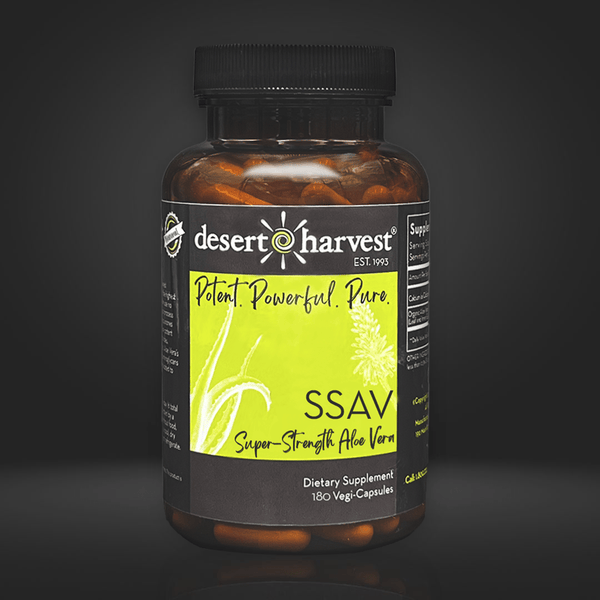
One option is Super-Strength Aloe Vera (SSAV) from Desert Harvest. It comes in a bottle of 180 capsules and is a purified, aloin-free, freeze-dried Aloe Vera concentrated 200:1, described as vegan and filler-free. It is a natural source of acemannan, which describes what is in the capsule, not what it does. The label amount is up to six capsules a day. It is distributed in Europe by Bivio Medical B.V., trading as Desert Harvest Europe.
Speak to your doctor or pharmacist before starting if you are pregnant or breastfeeding, take prescribed medicine (particularly for diabetes, heart rhythm, water tablets or blood thinners), or have a bowel condition such as Crohn's disease or ulcerative colitis. Never change prescribed medicine on your own. If bladder symptoms persist or get worse, or you have a fever, blood in your urine or pain in your back or side, see your GP.
Good to know