There is no single answer to Aloe Vera dosage, because the right amount depends almost entirely on the product in your hand. Aloe Vera supplements vary enormously in strength and form, so the number of capsules or millilitres that suits one preparation can be very different from another. The honest starting point is always the label on the pack and, if you are unsure, a quick word with your pharmacist.
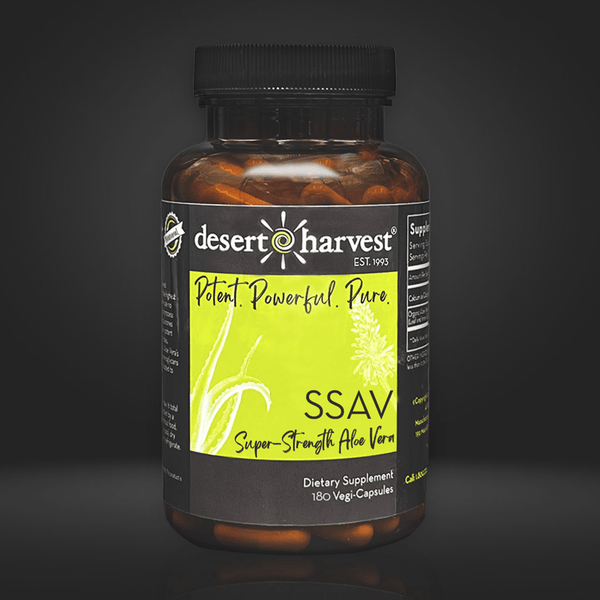
This guide looks calmly at how people actually take Aloe Vera as part of a bladder-friendly routine: how to read a label, how a daily habit tends to be structured, and why patience matters more than any single number. It is general education, not medical advice, and it is written for people exploring Aloe Vera as a food supplement for everyday wellbeing. Where it is useful, we also set out the specific routine and step-up schedule reported by people using Desert Harvest Super-Strength Aloe Vera (SSAV) — our own anthraquinone-free, 200:1 concentrate — because that is the product most of our readers are asking about. For the full reference version of these numbers in one place, see our Aloe Vera dosage guide.
The starting point: six capsules a day.
SSAV's recommended daily amount is six capsules a day — three in the morning and three in the evening — each with a full glass of liquid (about 240 ml). It works with or without food; the one habit worth keeping is avoiding a dose right at bedtime, so it does not add a night-time trip to the loo. In a 2016 survey of 660 Desert Harvest customers, 30% noticed a benefit within the first two weeks and 56% within the first month, and for many the effect keeps building over the first three months — so for a first trial, give it a full three months before you judge it. At six capsules a day a 180-capsule bottle lasts about a month, which is why a first order of three bottles — a three-month supply — is the sensible way to start. Super-Strength Aloe Vera.
Why "how much Aloe Vera" is the wrong first question
The most common search around this topic is some version of "how many Aloe Vera capsules should I take a day". It is a reasonable question, but it skips the step that really matters: what is in each capsule. A teaspoon of thin, ready-to-drink Aloe Vera juice and a single capsule of highly concentrated freeze-dried, purified Aloe Vera are not remotely comparable, even though both say "Aloe Vera" on the front.
So before counting capsules, it helps to understand concentration. Two products can carry the same plant name yet differ by a factor of a hundred or more in the Aloe Vera solids they deliver. That is why a sensible routine is built around the product's own serving guidance, not a number borrowed from a forum or a different brand. For SSAV specifically, that guidance is six capsules a day to start — the routine further down this page walks through what comes next if that is not quite enough.
Reading the label: concentration is everything

When you pick up any Aloe Vera supplement, a few details tell you far more than the headline marketing:
- Concentration or ratio. Freeze-dried products are often described with a ratio such as 200:1, meaning a large amount of fresh Aloe Vera is reduced to a small amount of stable powder. A higher ratio means more Aloe Vera solids per capsule.
- Has the aloin been removed? All Aloe Vera naturally contains aloin and related anthraquinones, the bitter compounds in the plant's latex. The detail that matters is not which part of the leaf a product names, but whether those compounds have been taken out. Look for words such as anthraquinone-free, aloin-removed, purified or decolourised.
- Anthraquinone-free or aloin-removed. This tells you the natural laxative compounds (aloin and related anthraquinones, present in all Aloe Vera latex) have been taken out. It is a composition fact and a quality marker, not a health claim.
- Serving suggestion. The manufacturer sets this for that exact formulation. It is the single most reliable number you have.
Our Super-Strength Aloe Vera (SSAV) is an example of the concentrated end of the scale: a freeze-dried, anthraquinone-free, 200:1 concentrated Aloe Vera food supplement in a 180-capsule pack. Because it is concentrated, the "right amount" is not the same as it would be for a dilute juice, which is exactly why the label, rather than a one-size-fits-all rule, is the place to look.
Freeze-dried capsules versus juice
People often ask whether capsules or juice are better, and the honest answer is that they are simply different formats. Juice is mostly water and can vary in strength between brands; freeze-dried capsules are more concentrated, consistent and portable. For a fuller comparison, see the rest of our Aloe Vera and the bladder articles.
SSAV's own routine: starting dose, stepping up, and finding your level
Because this is the question we are asked most often, here is the specific routine rather than just the shape of one. It follows Desert Harvest's own three-month protocol, used in the United States for thirty years, and what people report doing in practice.
- Month one — six a day. Three capsules in the morning, three in the evening, each with a full glass of liquid. This is the recommended daily amount on the label, and it is where everyone starts. Give it the full month before deciding whether it is enough.
- Month two — nine a day, if needed. If symptoms are still present after a full first month, Desert Harvest's protocol, and what many people report doing, is to step up to nine capsules — three in the morning, three in the afternoon and three in the evening.
- Month three — twelve a day, if needed. If nine is still not quite enough, the next step in Desert Harvest's protocol, and what some people report doing, is twelve a day — four in the morning, four in the afternoon and four in the evening.
Our label carries the standard food-supplement statement not to exceed the recommended daily amount of six capsules. Going above six is not an instruction from us: it is Desert Harvest's published protocol and what people report doing, and it is a step to take alongside a qualified healthcare professional who knows your history, particularly the first time you step up.
Once someone has found a level that keeps symptoms settled — six, or one of the higher steps above — what people describe next is working out a personal maintenance dose, which is usually lower than the level that got them there. A common pattern after the three months is to come down by one capsule a week, and stop reducing as soon as symptoms start to creep back, then settle a capsule above that point. Most people find their maintenance dose somewhere between three and nine capsules a day; it is genuinely individual, and it can take a few weeks of gentle trial and error to find. The full step-by-step version of this schedule, including the maintenance taper set out in one table, is on our Aloe Vera dosage guide.
In a flare: taking more, more often
A flare is different from an ordinary day, and the routine changes accordingly. Desert Harvest's guidance for a flare is six capsules every four hours until symptoms are back under control, rather than the usual twice-daily pattern. Most people report noticing a change after the first six capsules taken this way. Higher daily intakes have long been used without reported harm, but as with any step above the labelled six-a-day amount, this is guidance to follow alongside a healthcare professional who knows your history, not an instruction from us — our label's recommended daily amount remains six capsules.
Once a flare has settled, most people return to their usual maintenance dose rather than staying at the higher, every-four-hours level.
The rough first week: adjustment, not failure
If the first few days feel worse, that is known, and it passes.
Around two in a hundred people report a temporary increase in symptoms in the first few days of taking concentrated Aloe Vera — usually mild digestive discomfort or a change in bowel habits, as the body adjusts to concentrated Aloe Vera polysaccharides. This is not the laxative effect associated with ordinary Aloe Vera latex; SSAV is anthraquinone-free, so the aloin that causes that effect has already been removed. If it happens, dropping back to two capsules a day and building up again slowly over one to two weeks usually settles it. Stopping in the first week, before this settles, is the single most common way people miss out on the benefit — so if this is you, treat it as a sign the body is adjusting, not a reason to stop.
The patience part: Aloe Vera is a slow, daily habit

If there is one theme worth holding on to, it is patience. Food supplements are not medicines and should not be expected to behave like them. There is no overnight effect to chase, and chopping and changing every few days makes it impossible to judge how a routine suits you.
In a 2016 survey of 660 Desert Harvest customers carried out by the Interstitial Cystitis Association, 30% of respondents noticed a benefit within the first two weeks and 56% within the first month, with a further quarter noticing somewhere between one and three months. That spread is exactly why a three-month trial matters: a good part of the improvement people eventually report is still building well past the first few weeks. In a separate placebo-controlled study, 87.5% of those who completed the full trial period reported relief from at least some of their symptoms. That is not everyone — a minority genuinely do not respond, and it is worth being honest about that rather than promising otherwise.
Consistency works the other way too. Some people report symptoms returning within about 72 hours of stopping, which is a useful way to think about what this actually is: a daily routine you stay on, not a short course you finish and put away.
Most people who include Aloe Vera in a bladder-friendly routine think in weeks and months of consistent use, not days. A calm, unhurried approach also fits the wider reality of a sensitive bladder, where steady daily habits, sensible hydration and a measured diet usually matter more than any single product.
It is worth being clear about what we are and are not saying. Conditions such as interstitial cystitis or bladder pain syndrome (IC/BPS) are genuine medical conditions, and reputable charities such as the COB Foundation and Bladder Health UK are the right places to learn about them and find support. Aloe Vera is a food, not a treatment for any condition, and nothing here should be read as a claim that a supplement acts on a disease. For the wider picture of where Aloe Vera sits in this conversation, our pillar guide on Aloe Vera and the bladder brings the science, the EU rules and the daily routines together in one calm place.
Safety, sensitivity and who should check first
All Aloe Vera naturally contains aloin and related anthraquinones in its latex. Anthraquinone-free Aloe Vera is the gentler form because the aloin has been removed by a purifying, decolourising process, so it does not carry the laxative effect associated with aloin. Even so, tolerance is individual, which is another reason to start at the label's recommended six a day and build a routine slowly rather than beginning at a higher amount.
Some people should take particular care and seek advice before starting any new supplement:
- Anyone who is pregnant or breastfeeding.
- Anyone taking regular or prescription medication, since Aloe Vera can in theory interact with some medicines.
- Anyone managing an ongoing health condition who wants to be sure a supplement fits alongside their existing care.
In each case, your doctor or pharmacist is the right person to confirm that Aloe Vera is suitable for you, and the right person to talk to before stepping up beyond the labelled six-a-day amount. A food supplement is meant to complement a varied, balanced diet and a healthy lifestyle, never to replace them or any treatment your clinician has recommended.

Good to know
Frequently asked questions
How many Aloe Vera capsules should I take a day?
How long do people give an Aloe Vera routine?
Is it normal to feel worse in the first few days?
What do people do during a flare, and what happens if I stop taking it?
Is Aloe Vera safe for a sensitive bladder?
Can I take Aloe Vera alongside my other medication?

Desert Harvest Super-Strength Aloe Vera is a food supplement, distributed in Europe by Bivio Medical B.V. (Desert Harvest Europe). Food supplements are not a substitute for a varied, balanced diet or a healthy lifestyle. Do not exceed the recommended daily amount. If you are pregnant, breastfeeding, taking medication or have a medical condition, consult your doctor or pharmacist before use. Keep out of the reach of young children.