Type "Aloe Vera capsules" into a search box and you will find products that have very little in common. This page explains what is actually inside one, which kind is meant for daily use, and how people take them.
In short: a good Aloe Vera capsule holds freeze-dried, purified Aloe Vera powder in a plain shell, with the aloin removed. It is not a laxative. People usually take it twice a day with a full glass of water, and they give it weeks to months before judging it.
What is inside an Aloe Vera capsule?
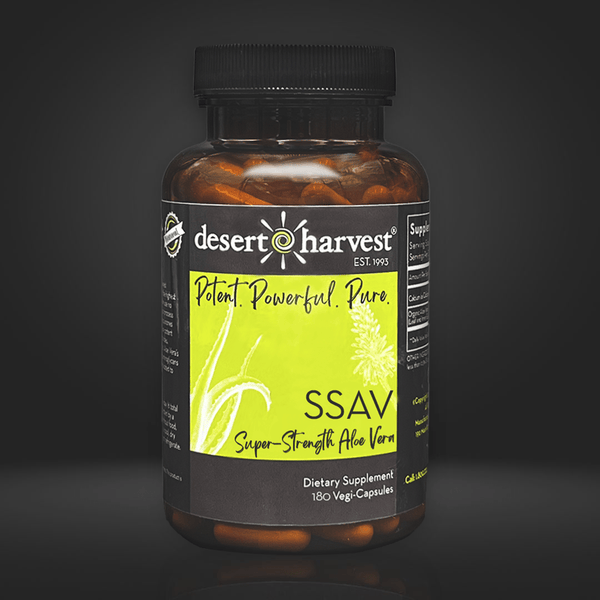
Only a few things. As an example, here is what is in the capsules we sell. Each one holds freeze-dried, purified, anthraquinone-free organic Aloe Vera powder. The shell is made of tapioca starch, so it is vegan. Besides the Aloe Vera, there is a little calcium carbonate and a tiny amount of silicon dioxide, which keeps the powder flowing.
You will often see a ratio such as 200:1. It means a large amount of fresh Aloe Vera has been reduced to a small amount of stable powder. Freeze-drying takes the water out at low temperature, so a capsule can hold a lot of Aloe Vera in a small space. If you want the detail, our freeze-dried versus juice guide explains it.
Three capsules together provide 1,800 mg of the 200:1 Aloe Vera and 60 mg of calcium, as calcium carbonate. A bottle holds 180 capsules.
Two very different products share the name
This is the part that confuses most people. Every Aloe Vera leaf carries a bitter yellow latex just under the rind. It contains aloin and related compounds called anthraquinones, and aloin is a strong natural laxative.

- Capsules that still contain aloin. These work as laxatives because of the aloin, and they are often bought for constipation. In 2021 EU food law restricted Aloe Vera preparations that contain aloin. An EU court annulled that rule in 2024, but Germany's food-safety institute, the BfR, still advises caution about aloin.
- Purified, anthraquinone-free capsules. The aloin has been taken out, and the label should say so. These are made for steady daily use. They are not a laxative, and they are not something to take for constipation.
If a label talks about the plant but says nothing about the aloin, treat that silence as a reason to look further. Our guide to choosing an Aloe Vera supplement shows what to look for on the pack.
Capsules, tablets or juice?
All three are on sale, and none is better for everyone. The useful comparison is what each one gives you and how easy it is to keep up.
- Capsules: a measured amount each time, no taste, easy to carry, and no refrigeration.
- Tablets: used in much the same way as capsules. As with any format, the full ingredient list and the way the strength is stated tell you more than the shape.
- Juice: easy to drink, but mostly water. The strength varies between brands, and some juices contain added acid or flavouring.
That last point is one reason some people with a sensitive bladder prefer capsules. There is no added acid or flavouring, the ingredient list is short, and the amount is the same every day. That is a matter of what people choose and report, not a promise about any condition.
How people take Aloe Vera capsules day to day
On our own capsules, the label says three capsules twice a day, six in total. Take each set with about 240 ml of clear liquid, which is a full glass. You can take them with or without food. Do not go above the daily amount on the label.

A few habits that people find helpful:
- Take one set in the morning and one in the evening.
- Avoid a dose right at bedtime, so it does not add a night-time trip to the loo.
- Choose water or another mild drink rather than something acidic.
- Keep the routine the same each day.
Some people want to know what happens after the first month. That is a longer conversation, and our guide to dosage routines and patience sets it out step by step. Any amount above the label is something to talk through with a healthcare professional who knows your history.
Can you open a capsule?
Yes. If capsules are hard to swallow, open one and mix the powder into a little water or a mild, non-acidic soft food. The taste is strong, so use a small amount and finish it straight away. We do not sell a loose powder version.
How long before you notice anything?
Slowly. People describe the change in weeks to months, not days, and most who notice something say so within the first three months. Some people notice sooner and some keep settling after that. A food supplement is not a medicine, and experiences differ. Judging it after a few days is too early.
Storage
Keep the bottle somewhere cool and dry, out of the reach of children. Do not refrigerate it.
Who should ask a doctor or pharmacist first
Even a gentle supplement is worth a quick conversation in some situations. Please ask your doctor or pharmacist before starting if:
- you are pregnant or breastfeeding;
- you take regular or prescription medicines, particularly for diabetes, heart rhythm, water tablets or blood thinners, because Aloe Vera could in theory interact with some medicines;
- you have kidney problems, a bowel condition such as Crohn's disease or ulcerative colitis, or another long-term condition you want to be sure fits with a supplement.
Please also see your GP if you have a fever, blood in your urine, pain in your back or side, or bladder symptoms that persist or get worse. A supplement is not a substitute for that check. Never stop or change a medicine you have been prescribed because of something you read here.
About the capsules we sell: Super-Strength Aloe Vera (SSAV) is Desert Harvest's freeze-dried, purified, anthraquinone-free Aloe Vera in capsules. It is concentrated 200:1, comes in a tapioca-starch capsule and has 180 capsules per bottle. Many people with a sensitive bladder use it. It is a food supplement, not a medicine, and Aloe Vera has no authorised EU health claims. You can read the label details on the Super-Strength Aloe Vera product page.
Good to know