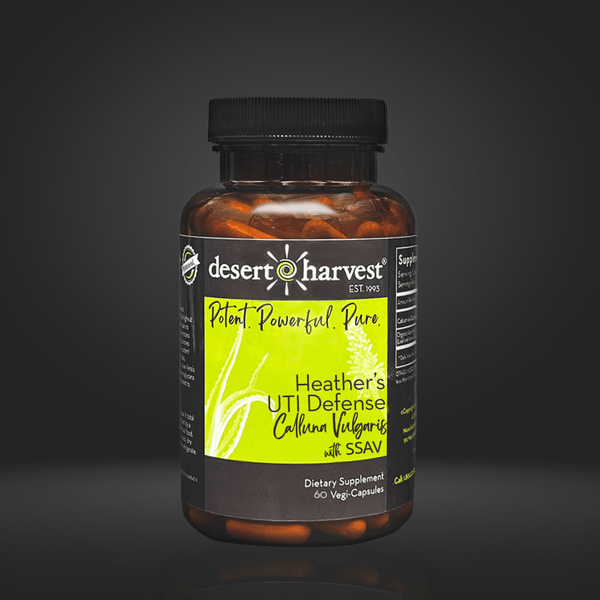
Among the natural options people explore for everyday urinary wellbeing, two ingredients dominate the conversation: cranberry and D-mannose. Yet there is a third, quietly European choice that the big brands tend to overlook — heather (Calluna vulgaris), a flowering shrub of Europe’s moors and heathlands with centuries of heritage in folk tradition. This guide takes a calm, evidence-aware look at heather, how it sits alongside the better-known options, and how it might fit into a sensible, bladder-friendly routine.
Meet heather (Calluna vulgaris)
Heather, known botanically as Calluna vulgaris and sometimes called common heather or ling, is a low-growing evergreen shrub in the Ericaceae family — the same plant family as bilberry and bearberry. It grows to roughly 20–50 cm tall and carpets acidic soils, moors and heathlands across Europe and into Asia Minor, turning vast landscapes purple in late summer.
From a composition point of view, heather flowers and shoots contain arbutin, a naturally occurring glucoside found across the Ericaceae family, alongside a range of polyphenols, flavonoids and tannins. These are simply facts about what the plant contains — not a claim about what any product does.
What makes heather interesting is its heritage. Across northern and western Europe, heather flowers were brewed as a flower tea and have long been culturally associated with the urinary system in traditional herbalism. These are traditional and cultural uses passed down over generations, rather than authorised health claims, and they are not a substitute for modern evidence.
Why heather is “the European answer”

Cranberry is, in essence, a North American story; D-mannose is a simple sugar usually produced in the laboratory or from birch. Heather, by contrast, is genuinely native to Europe — woven into the landscape and folklore of the Scottish Highlands, the Low Countries and the wider continent. For anyone drawn to a botanical with local roots rather than an imported berry or an isolated sugar, heather offers a distinctive, heritage-led alternative.
It is also an under-explored one. Search online for urinary wellbeing and you will find cranberry and D-mannose everywhere, but heather is largely absent. That gap is part of why we created our heather (Calluna vulgaris) food supplement, designed to sit within a daily urinary wellbeing routine — never as a medicine or a treatment.
What the evidence actually says
Being honest about the science is the most useful thing a brand can do here, so let us look at what the research shows for the popular options.
Cranberry. The 2023 Cochrane review of cranberry products (Williams and colleagues, drawing on around 50 trials) concluded that cranberry can reduce the risk of repeat, culture-confirmed urinary tract infections in some groups, including women with recurrent infections. Researchers have explored how cranberry’s proanthocyanidins (PACs) may interact with bacteria such as E. coli in the urinary tract. Where an effect is seen, it tends to be modest rather than dramatic.
D-mannose. The picture is more mixed. The large UK MERIT trial, published in JAMA Internal Medicine in April 2024, followed 598 women with recurrent urinary infections across 99 primary-care centres. It found no clear benefit from daily D-mannose over placebo: 51.0% of the D-mannose group and 55.7% of the placebo group had a medically attended infection over six months, a difference that was not statistically significant. An earlier 2022 Cochrane assessment had already rated the D-mannose evidence as low quality.
Heather. Heather has far less formal clinical research than either cranberry or D-mannose. Its case rests largely on long-standing European herbal tradition and on its composition, rather than on large modern trials. We think it is only fair to say so plainly.
A note on EU rules and honest language
In the European Union, food supplements are foods, not medicines. Under Regulation (EC) No 1924/2006, the European Food Safety Authority (EFSA) has not authorised any health claim for cranberry, D-mannose or heather in relation to urinary tract infections; every cranberry and D-mannose claim submitted so far has been rejected, and heather-related botanical functions sit on the EU’s “on-hold” botanical list. In practice this means that no brand, ours included, can lawfully say a supplement prevents, treats or reduces the risk of infections. What we can talk about is everyday urinary comfort and bladder wellbeing as part of a healthy routine. You can read more in our pillar guide to urinary comfort and bladder wellbeing.
Where heather fits in a bladder-friendly routine

No single ingredient is a magic answer, and the foundations of looking after your urinary tract are reassuringly ordinary. Patient charities such as Bladder Health UK and clinical bodies such as the European Association of Urology (EAU) — cited here as helpful sources rather than endorsements — broadly point to the same everyday habits:
- Stay well hydrated across the day, so that you are generally passing pale, clear urine.
- Do not delay going to the toilet when you need to, and take your time to empty fully.
- Pay attention to everyday hygiene and to anything that seems to be a personal trigger for you.
- Look after your wider wellbeing — sleep, balanced eating and regular movement all support the body as a whole.
A heather food supplement can sit alongside these habits as a natural daily companion, a thoughtful part of a healthy lifestyle rather than a replacement for any of them. If you would like to compare the main natural options side by side, the other articles in our urinary wellness series walk through cranberry, D-mannose and heather in more detail.
Is heather right for you?
Heather may appeal if you prefer a botanical with European heritage, you are looking for an alternative to cranberry, or you simply want a calm daily routine for your urinary wellbeing. Urinary comfort matters for everyone, not only women, and men are equally welcome to consider general urinary food supplements as part of a balanced routine.
That said, a food supplement is never a substitute for medical advice. If you have ongoing, severe or unusual symptoms — pain, burning, fever, or blood in your urine — please contact your GP or pharmacist promptly. If you are pregnant or breastfeeding, take regular medication, or have a health condition, check with a healthcare professional before starting any new supplement.
Good to know
Frequently asked questions
What is heather (Calluna vulgaris) traditionally used for?
Heather is a low-growing evergreen shrub of the Ericaceae family, native across Europe’s moors and heathlands. In European herbal heritage it has long been associated with the urinary system and was enjoyed as a flower tea for generations. These are traditional and cultural uses, not authorised health claims; no EU health claim has been authorised for heather in relation to the urinary tract.
What can I take instead of cranberry for urinary health?
Many people look beyond cranberry to options such as D-mannose or botanicals like heather (Calluna vulgaris). The most important everyday foundations remain good hydration and sensible habits. A heather (Calluna vulgaris) food supplement can sit alongside these as part of a daily urinary wellbeing routine. Choose products on quality and transparency, and ask a pharmacist if you are unsure.
Can men take urinary tract supplements too?
Yes. Urinary wellbeing matters at every age and for every gender, even though recurrent urinary issues are more often discussed among women. Men can take general urinary or bladder food supplements as part of a balanced routine. Anyone with ongoing or unusual urinary symptoms should see a doctor rather than rely on a supplement.
Can supplements replace antibiotics for a urinary infection?
No. Food supplements are not medicines and are not intended to diagnose, treat, cure or prevent any disease, including urinary tract infections. If you suspect an infection — pain, burning, fever or blood in the urine — contact your GP or pharmacist promptly. A supplement may form part of a general wellbeing routine, but it is not an alternative to medical care.
Heather (Calluna vulgaris) is offered here as a food supplement. Food supplements are not a substitute for a varied, balanced diet and a healthy lifestyle, and should not be used to diagnose, treat, cure or prevent any disease. This article is general educational information, not medical advice. If you have urinary symptoms or any health concern, please speak to your GP or pharmacist.