If you are looking after a sensitive bladder, the way Aloe Vera is processed can matter as much as the plant itself. The two formats people compare most often are Aloe Vera juice and freeze-dried Aloe Vera capsules. Both come from the same plant but differ in concentration, consistency and processing. This calm guide walks through those differences and what to look for on a label.
For the wider picture — what a sensitive bladder is and how Aloe Vera fits into daily life — see our pillar guide, Aloe Vera and the sensitive bladder.
First, what is actually in your Aloe Vera?
All Aloe Vera naturally contains a bitter yellow latex just beneath the green rind. That latex holds anthraquinones, including the compound aloin (also called barbaloin). The Aloe Vera itself is also a source of beneficial polysaccharides, including acemannan. The single most important thing to understand before comparing any two Aloe Vera products is not which fraction of the leaf is named on the pack, but whether the naturally occurring aloin and other anthraquinones have been removed. A purified, anthraquinone-free Aloe Vera has had that bitter latex fraction taken out by processing, while still carrying the acemannan-rich Aloe Vera. This is worth understanding before comparing any two products.
Aloe Vera juice: convenient, but variable

Aloe Vera juice is usually Aloe Vera pressed into a drinkable liquid, often diluted with water and sometimes blended with preservatives, flavourings or citric acid. Its appeal is obvious: it is easy to drink and widely available.
The trade-offs are worth knowing:
- It is mostly water. Because juice is largely water by weight, the Aloe Vera solids per serving are comparatively low and vary between brands and batches.
- Concentration is hard to read. Labels rarely state how concentrated the Aloe Vera is, so comparing juices is difficult.
- Added ingredients. Added acids or flavourings are worth checking if you follow a bladder-friendly diet, since many people with a sensitive bladder limit acidic or citrus inputs.
- Aloin content varies. Juices can carry more of the bitter latex compounds unless the Aloe Vera has been processed to remove the anthraquinones.
What “freeze-dried” actually means
Freeze-drying (lyophilisation) removes water from the Aloe Vera at low temperature under vacuum rather than with heat, leaving a dry, concentrated Aloe Vera powder behind. Two things follow from this:
- Concentration. With the water taken out, what remains is far more concentrated by weight, which is why freeze-dried Aloe Vera is often described with a ratio such as 100:1 or 200:1.
- Gentle processing. Because freeze-drying avoids high heat, it is generally regarded as a gentler way to stabilise the plant’s naturally occurring compounds than heat-based drying.
That concentrated powder is then measured into freeze-dried Aloe Vera capsules, which is where the format gets its name.
Freeze-dried Aloe Vera capsules: concentration and consistency

Freeze-dried, purified Aloe Vera in capsule form offers practical advantages for a predictable daily routine:
- A defined amount. Each capsule contains a measured quantity of Aloe Vera solids, so you know what you are taking each day.
- No taste. Capsules avoid Aloe Vera’s bitterness and any added flavourings.
- Travel-friendly. They are easy to carry and need no refrigeration, unlike many juices.
- Aloin can be removed. Quality capsules are made so that the aloin (anthraquinones) is removed, which we explain below.
Freeze-dried capsules vs juice at a glance
| Consideration | Freeze-dried capsules | Aloe Vera juice |
|---|---|---|
| Concentration | High; water removed, often 100:1–200:1 | Low; largely water by weight |
| Amount per serving | Measured per capsule | Varies by brand and batch |
| Taste | None | Bitter unless flavoured |
| Added ingredients | Usually minimal | Often water, acids, preservatives |
| Aloin | Removed in quality purified products | Variable; depends on processing |
| Convenience | Easy to carry; no refrigeration | Bulkier; may need chilling once opened |
Why anthraquinones and aloin are removed
The aloin-rich latex that every Aloe Vera leaf naturally contains has historically raised safety questions when consumed in quantity over a long period. For that reason, reputable Aloe Vera supplements are purified so that the aloin is removed, and many describe themselves as anthraquinone-free. This is a composition and quality marker, not a health claim.
The regulatory backdrop is genuinely interesting. In 2021 the European Commission restricted Aloe Vera preparations containing hydroxyanthracene derivatives — the family that includes aloin and aloe-emodin — in food, under Regulation (EU) 2021/468. In November 2024 the EU General Court annulled that Aloe Vera entry in case T-189/21 (Aloe Vera of Europe v Commission), leaving danthron as the main exception, and Germany’s BfR has separately advised caution on Aloe Vera preparations that still carry their anthraquinones. The practical takeaway is simple: an anthraquinone-free, aloin-removed Aloe Vera sits outside that debate by composition, whichever way the legal position settles. You can read more in our companion piece on anthraquinone-free Aloe Vera.
Aloe Vera and EU food-supplement rules
In the EU and UK, Aloe Vera supplements are foods, not medicines. Aloe Vera currently has no authorised EU health claims, so a responsible brand will describe its product in terms of composition and routine — for example “a freeze-dried, anthraquinone-free Aloe Vera food supplement” — rather than promising to treat or relieve anything.
Education about conditions such as interstitial cystitis or bladder pain syndrome belongs to charities and researchers; organisations such as the COB Foundation, Bladder Health UK and the European Association of Urology are useful sources, cited here for education rather than as endorsements. A food supplement is not a treatment for any condition, and nothing here should be read as suggesting otherwise.
Choosing Aloe Vera for a sensitive bladder: what to check
Whichever format you lean towards, a few label checks make comparison easier:
- Anthraquinones removed. The thing that really matters is not how the fraction of leaf is named, but whether the aloin and other anthraquinones have been taken out. Look for “anthraquinone-free”, “aloin removed”, “purified” or “decolourised”.
- Stated removal of aloin. A clear statement that the aloin has been removed is the single most useful quality signal.
- Concentration. A clear ratio (for example 100:1 or 200:1) or a stated milligram amount tells you how much Aloe Vera you are getting.
- Short ingredient list. Fewer added acids, sugars and flavourings is preferable on a bladder-friendly diet.
- Certification and transparency. Independent certification (such as IASC) and a brand that openly explains its process are reassuring.
Where Super-Strength Aloe Vera fits
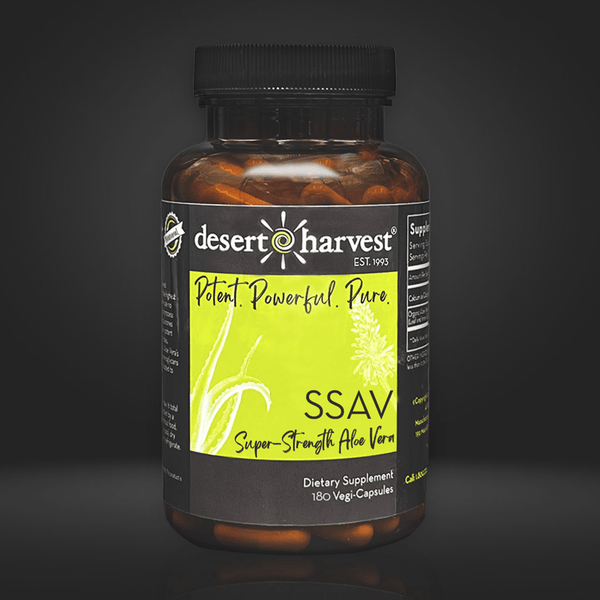
Desert Harvest Super-Strength Aloe Vera is one option in this category: a freeze-dried, anthraquinone-free Aloe Vera food supplement in capsule form — purified so that the aloin is removed and concentrated 200:1 — chosen by many people with a sensitive bladder as part of a calm daily routine. It is distributed across Europe by Bivio Medical B.V. (Desert Harvest Europe), and it is the same genuine Aloe Vera behind decades of community use.

Good to know
Frequently asked questions
Aloe Vera capsules vs juice — which is better for the bladder?
What is freeze-dried Aloe Vera and why does processing matter?
What are anthraquinones and aloin, and why are they removed from Aloe Vera?
Is Desert Harvest Aloe Vera available in Europe and the UK?

Food supplement. Aloe Vera food supplements are not a substitute for a varied, balanced diet or a healthy lifestyle, and they are not medicines: they do not treat, prevent or cure any disease. If you are pregnant, breastfeeding, taking medication or under medical care, speak to your doctor or pharmacist before use. Sources are referenced for education only, including EUR-Lex (Regulation (EU) 2021/468 and judgment T-189/21), the COB Foundation and Bladder Health UK.