Anthraquinone-free Aloe Vera is Aloe Vera that has had its naturally occurring anthraquinones — chiefly a compound called aloin — removed. All Aloe Vera naturally contains these bitter substances in the yellow latex just beneath the leaf skin. Taking them out leaves a milder, purified Aloe Vera that is better suited to gentle, everyday use.
If you have started reading the labels on Aloe Vera supplements, you have probably seen phrases like "anthraquinone-free", "aloin removed", "purified" or "decolourised". They sound technical, but the idea behind them is simple, and it matters more than the marketing suggests. This guide explains what anthraquinones and aloin are, where they come from, what "anthraquinone-free" really means, and why people with a sensitive bladder tend to pay attention to it.
What are anthraquinones and aloin?
Anthraquinones are a family of plant compounds. In Aloe Vera, the best known is aloin (sometimes called barbaloin), alongside related substances such as aloe-emodin. Collectively, regulators refer to them as hydroxyanthracene derivatives, or HADs.
Aloin is bitter and brightly coloured, and it is a well-documented stimulant laxative — historically that is exactly what Aloe Vera "latex" was used for. Because it can irritate the gut, it is not something most people want in a supplement they take every day. That is the practical reason careful Aloe Vera makers go to the trouble of removing it.
Where anthraquinones come from in the plant

An Aloe Vera leaf is not uniform, and that is the key to understanding aloin:
- The latex (or "sap"): a yellow, bitter layer just under the green skin. This is where aloin and the other anthraquinones are concentrated in every Aloe Vera leaf.
- The fleshy gel and its polysaccharides: Aloe Vera's prized components — including acemannan — along with vitamins, minerals and amino acids. The gel is roughly 99% water.
So whether an Aloe Vera product contains meaningful anthraquinones depends not on the plant — every Aloe Vera leaf naturally has aloin in its latex — but on how the Aloe Vera is processed. The thing that matters is whether the anthraquinones have been taken out. A purified, decolourised preparation has the aloin filtered out so only negligible traces remain; an untreated, unfiltered preparation keeps the bitter laxative fraction.
What "anthraquinone-free" actually means
"Anthraquinone-free" (or "aloin-free") means the finished Aloe Vera has had these compounds reduced to negligible levels — in practice through a decolourising and filtration step that strips out the aloin. The International Aloe Science Council, the industry's certification body, sets a commonly cited threshold of no more than 10 parts per million of aloin for products described this way.
It is worth being clear about what the term is and is not. "Anthraquinone-free" is a composition fact — a statement about what is, and is not, in the product. It is a quality and purity marker, not a health claim, and on its own it tells you nothing about whether Aloe Vera "does" anything for you. That distinction matters, both for honest label-reading and for EU rules, which we come to below.
Why it matters for a sensitive bladder

People living with a sensitive bladder — including those reading up on interstitial cystitis or bladder pain syndrome (IC/BPS) — often become very attentive to what they consume, because some find certain foods, drinks and additives less comfortable than others. UK charities such as the COB Foundation and Bladder Health UK publish balanced, well-referenced guidance on living day to day with these conditions, and they are sensible places to start.
In that context, a gentle, well-characterised ingredient is reassuring. Anthraquinone-free, purified Aloe Vera is chosen by many people as part of a calm daily routine precisely because the harsh, laxative fraction has been taken out and what remains is the mild, acemannan-rich material. None of this means Aloe Vera treats, prevents or relieves any bladder condition — it does not, and no food supplement should be presented that way — but it does explain why "anthraquinone-free" is the first thing careful shoppers look for. Our wider guide to Aloe Vera and the sensitive bladder puts this in fuller context.
Anthraquinone-free Aloe Vera and the EU rules
The legal background is genuinely interesting. In 2021 the European Commission adopted Regulation (EU) 2021/468, which restricted Aloe Vera leaf preparations containing hydroxyanthracene derivatives in food. In November 2024 the EU General Court annulled that restriction as it applied to Aloe Vera preparations (case T-189/21, Aloe Vera of Europe v Commission), leaving only danthron covered. Germany's BfR, for its part, still advises caution around Aloe Vera products that have not had their anthraquinones removed.
The helpful point for shoppers is that this entire debate concerns the anthraquinone fraction. An anthraquinone-free, purified Aloe Vera sits outside that concern by design, whichever way the legal position settles, because the compounds in question have already been removed. You can read more in our explainer on aloin and the EU rules.
How to spot anthraquinone-free Aloe Vera on a label
The single most important thing to look for is not which "part" of the leaf was used — every Aloe Vera leaf contains aloin in its latex — but whether that aloin has actually been taken out. With that in mind:
- The words themselves: "anthraquinone-free", "aloin-free", "aloin removed", "purified" or "decolourised".
- Processing: a decolourising or filtration step is what removes the aloin; "freeze-dried" preparations then keep the gel's polysaccharides intact while staying concentrated. See our piece on freeze-dried versus juice.
- Certification: an IASC seal, or a stated aloin limit such as under 10 ppm, shows the claim has actually been checked.
- Concentration: a ratio such as 200:1 tells you how concentrated the purified Aloe Vera material is.
Where Super-Strength Aloe Vera fits
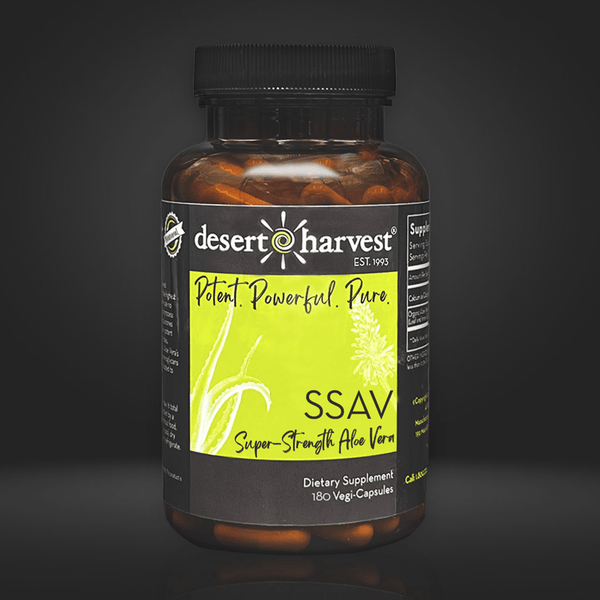
Desert Harvest Super-Strength Aloe Vera is a freeze-dried, anthraquinone-free Aloe Vera food supplement, concentrated 200:1 and naturally a source of Aloe Vera polysaccharides including acemannan. Its aloin is removed by a patented decolourising process, leaving a purified, gentle Aloe Vera. It is the Aloe Vera that many people with a sensitive bladder have chosen as part of their daily routine, and it is distributed across Europe by Bivio Medical B.V. (Desert Harvest Europe). As with any supplement, it is one option among several and not a substitute for a varied, balanced diet.

Good to know
Frequently asked questions
What are anthraquinones and aloin, and why are they removed from Aloe Vera?
Is Aloe Vera legal in food supplements in the EU?
Is Aloe Vera safe for a sensitive bladder?
What is the best Aloe Vera for interstitial cystitis?

Food supplement. Desert Harvest Super-Strength Aloe Vera is a food supplement and is not a substitute for a varied, balanced diet or a healthy lifestyle. It is not intended to diagnose, treat, cure or prevent any disease. Do not exceed the recommended daily intake. If you are pregnant, breastfeeding, taking medication or under medical care, consult your doctor or pharmacist before use. Keep out of the reach of young children.