Many women ask the same quiet question before they buy D-mannose: for how long? A few days, a few months, or every day for years? This page sets out what is known, what is not, and where a GP should come in.
In short: there is no official limit on how long D-mannose may be taken, and no proven timetable for when anyone notices a change. The largest recent trial gave it daily for about six months and found no clear benefit over a placebo. If symptoms are present, see your GP rather than waiting on a supplement.
How long have studies given D-mannose?
D-mannose is a simple sugar. Most of it is not used for energy and passes into the urine within a few hours. That is why researchers became interested in it, and why it is usually taken regularly rather than once.
The study people quote most is the 2024 MERIT trial, published in JAMA Internal Medicine. It followed 598 women with repeat urinary infections in UK primary care. They took D-mannose or a placebo every day for about six months. The authors found no clear benefit over the placebo.
An earlier Cochrane review, from 2022, rated the wider evidence as low or very low quality. So about six months of daily use is what the most widely quoted large study looked at, and it did not show a clear gain. For the amounts used, see our guide to D-mannose dosage and timing.
Can you take D-mannose every day?
Daily use is the usual way it is taken, and it is generally well tolerated. Because it is a sugar, there are a few points to keep in mind.

- If you have diabetes, or any condition that affects blood sugar, ask your doctor or pharmacist first.
- If you are pregnant or breastfeeding, or have kidney problems, ask your GP before you start.
- If you take prescribed medicines, tell your pharmacist what you plan to add.
- Stay with the amount on the label. More is not known to be better.
Some people take it for a short spell and then stop. Others keep to a daily routine for months. Neither choice has been shown to be the right one, so a sensible approach is to decide on a length of time, write it down, and check in with your pharmacist or GP when that time is up.
How long before you notice anything?
Many women want to know this, and the honest answer is that nobody can promise a date. D-mannose leaves the body in the urine within a few hours, and the MERIT trial did not show a clear difference from a placebo over six months. So there is no week or month at which a change can be expected.
It also helps to know why no firm claim can be made. The European Food Safety Authority has examined the urinary health claims put forward for D-mannose and cranberry and has not accepted any of them. That is why no supplement sold in the EU may say it prevents or treats a urinary infection. You can read more in why EU supplements cannot make these claims.
If you start D-mannose, see it as a small part of your day, next to drinking enough water and not holding on when you need the loo. Do not use it as a reason to put off a call to your GP.
How does it sit with your stomach?
Most people tolerate D-mannose well. Because it is a sugar, larger amounts can unsettle the stomach in some people. If you notice that, stop and ask your pharmacist. Some people find that spreading the daily amount over two or three servings sits more easily.

A few simple habits can make a daily routine easier to keep:
- Take it with a full glass of water.
- Link it to a meal you already eat, so it becomes part of your day.
- Keep a short note of how you feel, so you can tell your GP or pharmacist exactly what you noticed.
When to stop and see your GP
A supplement is never a reason to wait. Book an appointment, or speak to a pharmacist, if you have any of these:
- burning when you pass urine, or needing to go much more often than usual
- cloudy urine, or any blood in it
- pain in your lower tummy, back or side
- a fever, or feeling shivery and unwell, which needs urgent advice
- symptoms that last, return, or get worse while you are taking D-mannose
Tell your GP if infections keep coming back. Having two in six months, or three in a year, is worth a proper conversation. Our page on why urinary infections recur explains what a GP may look at, including the changes that come with the menopause. Never stop or change a medicine your doctor has prescribed without asking them.
A botanical option, plainly described
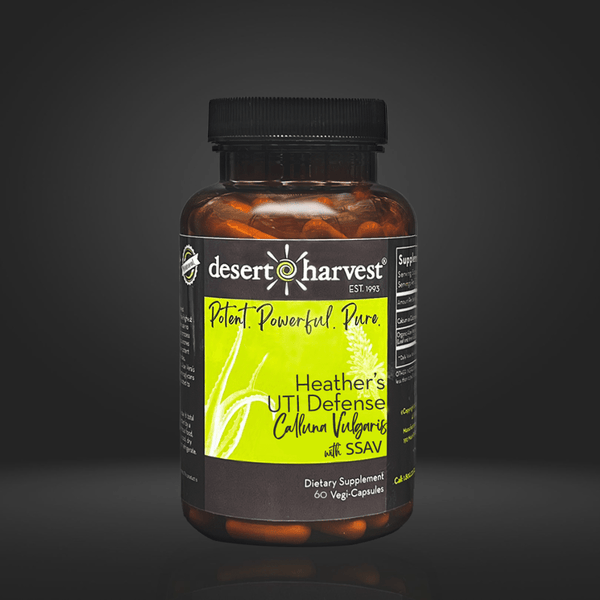
We do not sell D-mannose. We do sell Heather's UTI Defense, a food supplement. Each capsule holds 300 mg of heather (Calluna vulgaris), a plant with a long place in European herbal tradition, and 300 mg of purified, anthraquinone-free Aloe Vera. The directions are one capsule a day with a full glass of water, and a pot of 60 capsules lasts two months. It is meant to be taken every day as part of a steady routine, rather than now and then. It is not a medicine and carries no authorised health claim. If you are pregnant, breastfeeding or taking prescribed medicines, speak to your pharmacist or GP first.
Good to know